Description
The 8th Course on Laparoscopic Inguinal Hernia Repair: TAPP/TEP Approaches and Robotic Surgery Training with the da Vinci Xi, organized by the Jesús Usón Minimally Invasive Surgery Centre, is a highly specialized educational program designed for general surgeons and surgical specialists seeking to enhance their expertise in laparoscopic inguinal hernia repair using the transabdominal preperitoneal (TAPP) and totally extraperitoneal (TEP) techniques, both widely recognized as established approaches in minimally invasive surgery.
The course provides a comprehensive educational experience that integrates anatomical knowledge, surgical indications, and key technical considerations with intensive hands-on training in a highly specialized learning environment.
Throughout the theoretical sessions, participants gain an in-depth understanding of the anatomy of the inguinal region from a laparoscopic perspective, the peritoneal anatomical planes, and the indications for minimally invasive surgical approaches. The sessions also cover the technical principles of the transabdominal preperitoneal (TAPP) and totally extraperitoneal (TEP) approaches, including mesh selection, fixation techniques, and the prevention of surgical complications.
These topics are complemented by audiovisual materials and case-based discussions, facilitating a comprehensive understanding of each step of the surgical procedure.
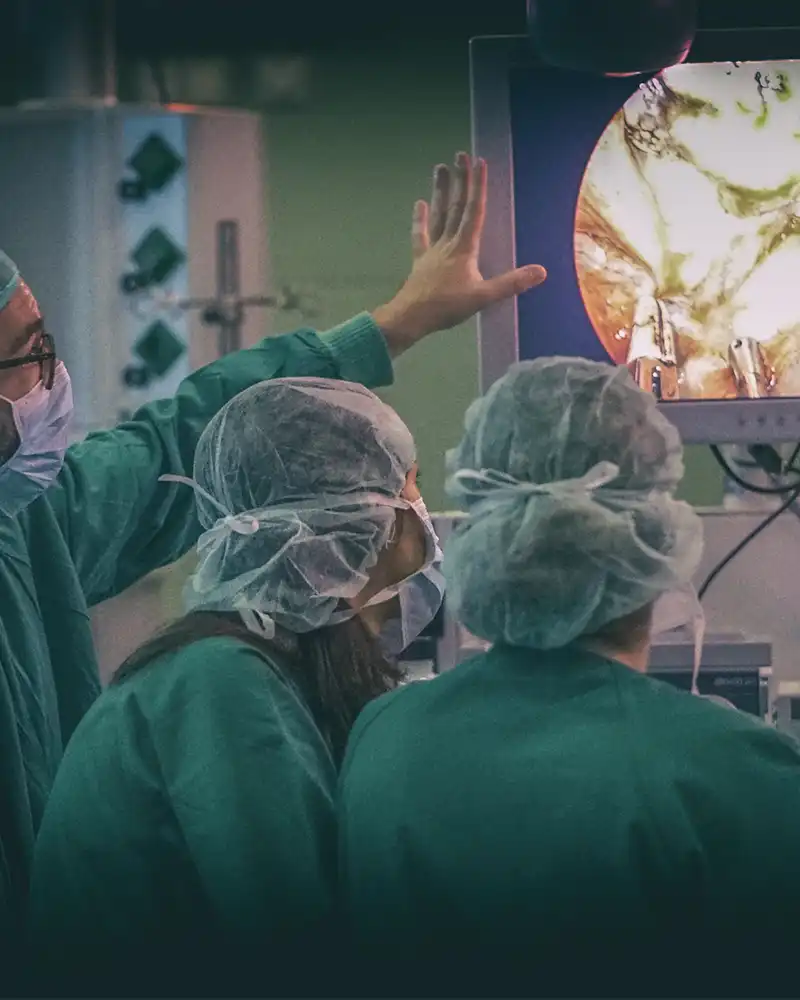
The practical training program plays a central role in the course and is conducted using experimental models, allowing participants to perform TAPP and TEP procedures under the direct supervision of experienced faculty members. This hands-on approach enables participants to refine their surgical techniques, improve anatomical orientation, and optimize laparoscopic ergonomics.
As part of the educational program, the course includes a dedicated robotic surgery training module using the da Vinci Xi surgical system. Participants rotate through simulation-based training sessions designed to develop and enhance essential surgical skills, including console operation, instrument manipulation and coordination, suturing, and knot tying. This training provides participants with valuable insight into the capabilities and potential applications of robotic platforms in minimally invasive surgery.
The educational program also incorporates a structured assessment of theoretical knowledge and practical skills, including a systematic analysis of performance outcomes and potential technical errors. This evaluation process is designed to promote continuous improvement, reinforce surgical proficiency, and consolidate the competencies acquired throughout the course.
This training activity offers a high-level professional development opportunity aimed at improving surgical practice in abdominal wall surgery, facilitating direct knowledge transfer to clinical practice within an excellence-driven environment such as CCMIJU, characterized by its practical focus, scientific rigor, and commitment to patient safety and quality.
Course Directors:
Dr. Carlos Fernández Quesada (Hospital Perpetuo Socorro de las Palmas. Las Palmas de Gran Canaria.)
Dr. Francisco Alba Mesa (Hospiten Roca. Universidad Fernando Pessoa. Las Palmas de Gran Canaria.)
Dr. Francisco Miguel Sánchez Margallo (Scientific Director, CCMIJU)
Faculty:
Dr. Carlos Fernández Quesada (Hospital Perpetuo Socorro de Las Palmas, Las Palmas de Gran Canaria)
Dr. Francisco Alba Mesa (Hospiten Roca, Fernando Pessoa University, Las Palmas de Gran Canaria)
Dr. Pau Plá Sánchez (Hospital Universitario de Gran Canaria Dr. Negrín. Las Palmas de Gran Canaria.)
Technical Secretariat:
Belén García: bgarcia@ccmijesususon.com
DAY 1
Monday, October 26
2:15 PM – 5:30 PM
2:15 PM – REGISTRATION AND DISTRIBUTION OF COURSE MATERIALS
2:30 PM – OPENING REMARKS AND COURSE INTRODUCTION
2:45 PM – THEORETICAL SESSION / VIDEO PRESENTATIONS
Anatomy of the inguinal region from a laparoscopic perspective.
Peritoneal anatomical planes of the inguinal region.
Indications for laparoscopic approaches.
4:00 PM – COFFEE BREAK
4:30 PM – THEORETICAL SESSION / VIDEO PRESENTATIONS
Technical aspects of the transabdominal preperitoneal (TAPP) approach in an experimental model.
Technical aspects of the totally extraperitoneal (TEP) approach in an experimental model.
Types of surgical mesh.
Mesh fixation techniques.
5:30 PM – END OF DAY 1
Day 2
Tuesday, October 27
9:00 AM – 5:30 PM
9:00 AM – HANDS-ON TRAINING USING EXPERIMENTAL MODELS AND A ROBOTIC SURGICAL PLATFORM
TAPP and TEP approaches using experimental models.
Rotational training and practical exercises on the da Vinci robotic surgical system.
11:00 AM – COFFEE BREAK
11:30 AM – HANDS-ON TRAINING USING EXPERIMENTAL MODELS AND A ROBOTIC SURGICAL PLATFORM
TAPP and TEP approaches using experimental models.
Rotational training and practical exercises on the da Vinci robotic surgical system.
2:00 PM – LUNCH BREAK
3:00 PM – HANDS-ON TRAINING USING EXPERIMENTAL MODELS AND A ROBOTIC SURGICAL PLATFORM
TAPP and TEP approaches using experimental models.
Rotational training and practical exercises on the da Vinci robotic surgical system.
4:30 PM – DEMONSTRATION OF ROBOT-ASSISTED TAPP AND TEP SURGICAL TECHNIQUES
5:30 PM – COURSE CLOSING